What Is Sofwave | How It Works | Results | Side Effects | Other Treatments | FAQs
Sofwave Treatment: A Dermatologist’s Evidence-Based Guide for Mumbai Patients
Why Sofwave Is Getting Attention for Non-Surgical Skin Tightening?
Many patients want firmer skin around the brows, jawline and neck without surgery or prolonged recovery. That has increased interest in Sofwave treatment, a non-invasive ultrasound technology designed to create controlled heating within the dermis and stimulate gradual collagen remodelling.
The current US FDA clearance includes improvement of facial lines and wrinkles, eyebrow lifting, lifting of lax submental and neck tissue, acne scars, short-term improvement in cellulite appearance and upper-arm skin laxity in specified contexts. Clearance, however, does not predict the result for an individual patient. [1]
For someone considering Sofwave treatment in Mumbai, the important question is whether its treatment depth and biological effect match the actual cause of the ageing change. Published evidence includes a broader ultrasound review, a small facial-laxity trial and an early Asian acne-scar study, so findings should be interpreted by indication rather than treated as one uniform body of proof. [2,3,4]
What Is Sofwave?
What Does “Synchronous Parallel Ultrasound” Mean?
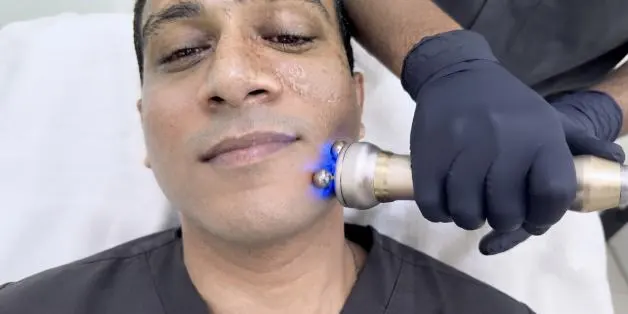
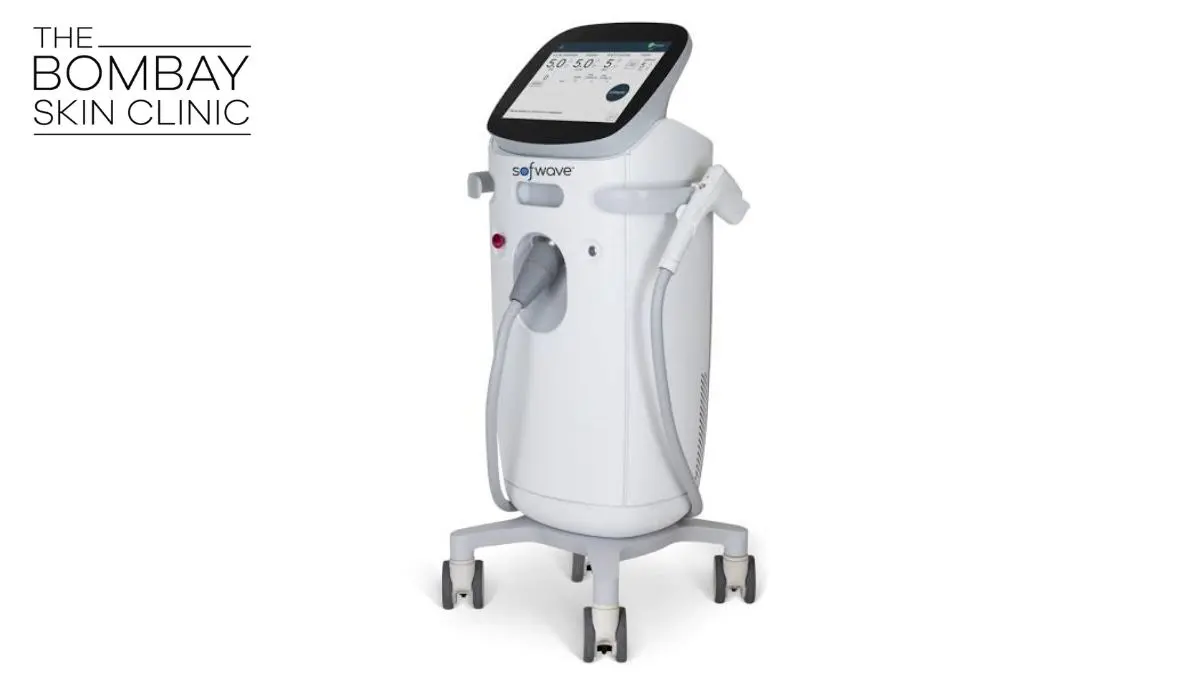
Sofwave delivers high-intensity, non-focused ultrasound in parallel beams. These beams create controlled thermal zones in the dermis while the surface is cooled. The intention is to trigger tissue repair without removing the epidermis. [1,2]
Which Skin Concerns Is Sofwave Designed to Address?
In facial aesthetics, interest centres on mild to moderate laxity, fine lines and changes around the brow, lower face, under-chin area and neck. FDA clearance is broader, but evidence strength is not identical for every indication. [1]
Sofwave Is Ultrasound, Not a Laser or Radiofrequency Treatment
Lasers use light, radiofrequency devices use electrical energy to generate heat, and Sofwave uses acoustic ultrasound energy. These technologies may all stimulate remodelling, but they differ in energy distribution, depth and intended tissue target.
How Does Sofwave Work?
Why Sofwave Targets the Mid-Dermis?
Sofwave is designed around mid-dermal treatment, commonly described at about 1.5 mm depth. This is shallower than many focused ultrasound protocols that target deeper tissue planes. Its main concept is dermal remodelling rather than deep structural repositioning. [2]
Controlled Heat, Fibroblast Activation and Collagen Remodelling
Controlled heat produces a repair response. Fibroblasts participate in producing and reorganising extracellular matrix proteins, including collagen. The visible effect, when it occurs, develops gradually because this is a biological remodelling process rather than an instant mechanical lift.
What Happens to Collagen and Elastin After Treatment?
Histological research has reported increased collagen, elastin and glycosaminoglycans with ongoing matrix reorganisation after synchronous parallel ultrasound. Some authors were affiliated with the manufacturer, so the mechanistic findings are useful but should still be interpreted with appropriate caution. [5]
Why Do Patients Consider Sofwave?
When Mild Skin Laxity Is the Main Concern
The treatment concept fits better when early dermal looseness or fine creasing is the dominant issue. Marked jowling, heavy tissue descent or major volume loss usually involves deeper anatomy that a mid-dermal treatment cannot fully address.
The Appeal of a Non-Invasive Treatment With Limited Recovery Time
Because the epidermis is not intentionally removed, recovery is generally expected to be shorter than with ablative procedures. That is attractive for busy patients, but limited visible downtime should not be confused with zero biological effect or zero risk.
Why Subtle Improvement May Be More Appropriate Than Aggressive Lifting for Some Faces?
Not every face needs a dramatic change. For early laxity, a modest improvement in firmness may look more proportionate than aggressive lifting. The treatment goal should respect facial anatomy rather than chase the largest possible change.
Who May Be a Suitable Candidate for Sofwave?
The Skin Laxity and Ageing Patterns That May Respond
Potential candidates are more likely to have mild or moderate laxity, fine lines or early softening around the brow, jawline, submental area or neck. Assessment should first separate skin laxity from fat, muscle pull, skeletal support and volume loss.
Why Facial Anatomy, Skin Thickness and Volume Distribution Matter?
Two people of the same age may need different plans. A fuller face with early skin laxity is not the same problem as a thin face with hollow cheeks and reduced support. Treatment choice should follow anatomy.
Who I Would Be Cautious About Selecting for Ultrasound Skin Tightening?
I would be cautious when the main concern is marked facial deflation, severe laxity, active inflammation, significant hollowing or an expectation that a non-surgical device will reproduce a facelift. Medical and procedural history also matters.
When I Would Advise Against an Energy-Based Tightening Procedure
If the expected benefit is too small, or if tightening may worsen the appearance of an already volume-deficient face, I would not recommend energy simply because a device is available. Declining an unsuitable procedure is part of sound aesthetic judgement.
What Results Can Sofwave Realistically Achieve?
Skin Tightening Versus an Actual Surgical Lift
Sofwave is a non-surgical skin-remodelling treatment. It does not remove redundant skin or surgically reposition deep facial tissues. A suitable patient may still value a smaller, gradual change, but the comparison with surgery should remain realistic.
Fine Lines, Brow Position, Jawline and Neck Laxity
FDA-cleared facial indications include lines and wrinkles, eyebrow lifting, and lax submental and neck tissue. Small clinical studies have reported improvement in treated areas, but the available patient numbers remain modest. [1,3]
Why Results Can Vary Significantly Between Patients?
Outcome depends on baseline laxity, age, collagen biology, facial volume, treatment parameters and what the patient considers meaningful improvement. One device cannot correct every layer of facial ageing.
What Current Studies Tell Us, and What They Still Cannot Tell Us?
A prospective study of 15 adults treated twice reported improvement at three and six months. That is encouraging, but the sample is too small to predict results across a large, diverse population. Larger independent comparisons would strengthen the evidence. [3]
What Are the Side Effects and Risks of Sofwave?
Common Short-Term Effects Such as Redness, Swelling, Tenderness and Discomfort
Temporary redness, swelling, tenderness and treatment discomfort are consistent with controlled dermal heating. Published studies have generally reported favourable short-term safety, but small trials can miss uncommon adverse events. [2,3]
Less Common and Reported Adverse Outcomes
With energy-based procedures, clinicians should remain alert to unexpected prolonged pain, swelling, altered sensation, skin injury or contour change. Small studies cannot reliably establish the true frequency of rare complications.
Why Device Clearance Does Not Mean Every Patient or Treatment Setting Is Risk-Free
FDA 510(k) clearance means substantial equivalence to legally marketed predicate devices for stated indications. It does not mean every patient will benefit, complications cannot occur, or every promotional claim has been independently proven. [1]
The Importance of Conservative Patient Selection and Appropriate Technique
Safety depends on more than the machine. Patient selection, treatment depth, energy choice, anatomical knowledge, contraindications and follow-up all influence the risk-benefit balance.
Where Sofwave Fits in My Clinical View, and Why I Do Not Currently Offer It
I do not currently offer Sofwave in my practice. I therefore assess it as a dermatologist deciding where a technology fits, rather than presenting it as a service.
The mechanism is credible, regulatory clearance is established for specific indications, and published studies show encouraging signals. However, much of the clinical evidence still comes from small cohorts. I would choose treatment according to anatomy, depth and evidence, not novelty.
When Would I Consider Other Treatments Instead of Sofwave?
When Deeper Facial Laxity Requires a Different Ultrasound Approach
If the main problem lies deeper than the dermis, a technology designed for deeper tissue planes may be more logical. This does not make one device universally superior. It means the anatomical target is different.
When Radiofrequency-Based Tightening May Be More Appropriate
Radiofrequency platforms differ widely in delivery method and depth. Some are designed for dermal remodelling, deeper bulk heating or fractional treatment. The comparison should be based on tissue target and clinical goal, not only on device category.
When Skin Texture, Scarring or Pigmentation Is the Bigger Problem Than Laxity
If texture, scarring or pigmentation is the dominant concern, tightening may not be the first priority. In Indian skin, clinicians should also consider the possibility of post-inflammatory pigmentation after procedures that create significant inflammation.
When Volume Loss or Structural Ageing Cannot Be Solved by Skin Tightening Alone
A hollow cheek, reduced chin support or deeper tissue descent will not be fully corrected by heating the dermis. Increasing energy cannot convert a skin-tightening treatment into a complete solution for structural ageing.
Sofwave vs HIFU and Microfocused Ultrasound: What Is the Clinical Difference?
Treatment Depth Is More Important Than the Device Name
HIFU and microfocused ultrasound cover different devices and protocols. Some create focal thermal zones at deeper levels than Sofwave. The useful comparison is where the energy is deposited and which tissue response is intended. [2]
Mid-Dermal Remodelling Versus Deeper Tissue Targeting
Sofwave centres on mid-dermal remodelling. Deeper ultrasound systems may target deeper connective tissue planes. A patient with superficial skin crepiness and one with deeper tissue descent should not automatically receive the same technology.
Why I Would Choose According to Anatomy Rather Than Trends
When comparing Sofwave vs HIFU, I would begin with the face rather than the brand. Where is the laxity? Is there volume loss or excess fat? How thick are the soft tissues? Those answers determine whether ultrasound makes sense.
How Doctors Personalise Sofwave and Other Skin-Tightening Treatments
Matching Treatment Depth to the Patient’s Actual Ageing Pattern
Dermal laxity, deeper ligamentous change, fat redistribution and skeletal ageing contribute differently in each person. Personalisation means identifying the dominant layer and choosing treatment that reaches it appropriately.
Why Thin Faces and Volume-Deficient Faces Need Particular Caution
In a naturally thin or hollow face, tightening alone may not create the desired aesthetic effect. Such patients may benefit more from preserving support than from pursuing additional tissue contraction.
Treating Skin Quality, Laxity and Volume as Separate Problems
I separate the questions: Is the skin surface healthy? Is the dermis lax? Is there volume loss? Is there deeper descent? Once these are distinguished, treatment planning becomes clearer and overtreatment becomes less likely.
When Combination Treatment Makes More Sense Than Increasing Energy
Several modest interventions aimed at different problems can sometimes be more rational than pushing one device harder. Every component of a combination plan should have a defined anatomical purpose.
How Can Sofwave Be Combined With Other Aesthetic Treatments?
Combining Collagen Stimulation With Treatments for Skin Texture
If a patient has both laxity and surface texture concerns, clinicians may use separate modalities for separate targets. Timing should allow recovery and make it possible to assess the contribution of each treatment.
Where Injectables May Address Problems Ultrasound Cannot
Injectables may address selected volume, contour or muscle-related concerns that ultrasound does not directly treat. That does not mean every patient needs a combination. Different tools simply solve different anatomical problems.
Why Treatment Sequence and Timing Matter
Energy devices, injectables and resurfacing procedures affect tissue differently. Sequencing should be planned rather than casually stacked, both for safety and so that the effect of each intervention can be understood.
Why More Treatments Do Not Automatically Produce Better Results
More sessions, more devices or higher energy do not automatically produce a better aesthetic outcome. The endpoint should be an appropriate degree of improvement with a reasonable risk profile.
What Makes Sofwave Scientifically Interesting?
The Concept of Parallel Ultrasound Beams and Controlled Dermal Heating
FDA documentation describes high-frequency ultrasound pulses that raise dermal temperature and create controlled, isolated thermal injury, with active cooling at the applicator surface. This combination of dermal heating and epidermal protection is central to the technology. [1]
Evidence for Neocollagenesis, Neoelastogenesis and Extracellular Matrix Remodelling
Neocollagenesis and neoelastogenesis refer to formation and reorganisation of collagen and elastin. Histological findings also suggest changes in glycosaminoglycans, supporting a biological basis for gradual dermal remodelling after treatment. [5]
What Histological Studies Add to Our Understanding
Histology shows tissue-level change rather than only visible appearance. A 2025 study reported changes in collagen, elastin and glycosaminoglycans over follow-up to ten months. That supports ongoing remodelling, but it cannot predict the visible benefit for every patient. [5]
The Important Limitations of the Current Sofwave Evidence Base
The literature is growing, but many studies are small, single-centre or focused on narrow indications. There is limited head-to-head evidence showing which patient profiles benefit more from Sofwave than from competing energy technologies.
How I Interpret the Data?
Small studies can identify useful signals but are weaker for rare adverse events and subgroup analysis. Industry involvement does not automatically invalidate research, but independent replication matters. I would describe the evidence as promising, not definitive.
What Does the Evidence Say About Sofwave in Asian and Indian Skin?
Why Skin of Colour Deserves Separate Consideration
Indian skin tones require thoughtful procedural planning because inflammation can sometimes lead to post-inflammatory hyperpigmentation. Sofwave does not intentionally remove the epidermis, but suitability still depends on skin condition, anatomy and treatment technique.
What Early Asian Patient Data Tell Us
A retrospective study of 14 Thai patients assessed synchronous parallel ultrasound for facial acne scars with follow-up to eight months. It reported improvement and no adverse events in that small cohort. Importantly, this was an acne-scar study, not an Indian facial-laxity trial. [4]
What We Still Do Not Know About Long-Term Outcomes in Indian Patients
Large, high-quality Indian studies defining long-term Sofwave outcomes, selection criteria and uncommon adverse effects across different Indian skin tones and facial structures are still limited. Overseas data should not be assumed to answer every local clinical question.
How I Would Evaluate Sofwave Before Choosing It?
Is the Problem Really Skin Laxity?
A blurred jawline can come from lax skin, submental fat, muscle anatomy, deeper tissue descent or several factors together. I would identify the dominant cause before choosing a tightening technology.
Is the Target Tissue at the Depth the Device Treats?
If the main problem lies deeper than the treatment zone, a mid-dermal device may have limited impact. Matching treatment depth to the anatomical problem is a core principle in energy-based aesthetics.
Is There Pre-Existing Facial Volume Loss?
Volume loss changes the risk-benefit calculation. A patient who already looks hollow may value support and softness more than additional tightening.
Are the Expected Improvements Proportionate to the Treatment?
I would ask whether the likely change justifies the procedure, discomfort, expense and uncertainty for that patient. A technically possible treatment is not always a clinically worthwhile one.
Is Another Technology Better Matched to the Patient’s Anatomy?
The answer may be ultrasound, radiofrequency, resurfacing, injectables, surgery, a combination, or no procedure. The decision framework should remain anatomy first, technology second.
Patient Questions I Often Get
How painful is Sofwave treatment?
Discomfort varies. A small facial laxity study reported a mean pain score of 5.6 out of 10. Patients may feel heat or short pulses of discomfort, so it should not automatically be described as painless. [3]
How long does it take to see Sofwave results?
Because the treatment relies on tissue remodelling, improvement is expected to develop gradually. Clinical and histological studies assess change over months rather than only immediately after treatment. [3,5]
How long can Sofwave results last?
Histological evidence shows remodelling over many months, but that does not establish a fixed duration of visible cosmetic benefit. Ageing continues, and long-term appearance varies between individuals. [5]
Can Sofwave reduce jowls or loose skin under the chin?
It may improve selected cases of mild laxity, and FDA clearance includes lifting lax submental and neck tissue. Heavy jowling caused by deeper descent or volume change may require a different strategy. [1]
Is Sofwave suitable for Indian skin tones?
Its non-ablative ultrasound mechanism does not intentionally remove the epidermis, which is relevant in skin of colour. However, dedicated Indian outcome data remain limited, so suitability should still be individualised.
What should I ask before choosing an ultrasound skin-tightening treatment in Mumbai?
Ask what tissue layer is being targeted, why that depth matches your concern, what improvement is realistic, what side effects can occur, and what alternatives may fit better. A good consultation should explain why a treatment suits your anatomy.
Citation Sources
US FDA SofWave System 510(k) Clearances and Indications for Use (accessdata.fda.gov)
[1] U.S. Food and Drug Administration. SofWave System K250146: 510(k) Premarket Notification and Indications for Use. 2025. https://www.accessdata.fda.gov/cdrh_docs/pdf25/K250146.pdf
Ultrasound Therapy for the Skin, Facial Plastic Surgery Clinics of North America (pubmed.ncbi.nlm.nih.gov)
[2] Wong A, Lowery AS, Bloom JD. Ultrasound Therapy for the Skin. Facial Plast Surg Clin North Am. 2023;31(4):503-510. https://pubmed.ncbi.nlm.nih.gov/37806683/
Clinical Study of High-Intensity, High-Frequency Non-Focused Ultrasound for Facial Skin Laxity (pubmed.ncbi.nlm.nih.gov)
[3] Gold MH, Biron J. Efficacy and safety of high-intensity, high-frequency, non-focused ultrasound parallel beams for facial skin laxity. J Cosmet Dermatol. 2024;23(1):117-123. https://pubmed.ncbi.nlm.nih.gov/38031530/
Asian Patient Study of Synchronous Parallel Ultrasound for Facial Acne Scars (pubmed.ncbi.nlm.nih.gov)
[4] Boonchoo K, Hongcharu W. The efficacy and safety of a single treatment of high-intensity, high-frequency, non-focused ultrasound parallel beams for facial acne scars in Asian patients: a preliminary study. J Cosmet Dermatol. 2025;24:e70134. https://pubmed.ncbi.nlm.nih.gov/40132902/
Histological Evidence of Long-Term Extracellular Matrix Remodelling After Synchronous Parallel Ultrasound (pubmed.ncbi.nlm.nih.gov)
[5] Carruthers J, Benitez Roig V, McDaniel DH, Jackson B, Bedich O, Amir R, et al. Synchronous Parallel Ultrasound Induces Long-Term Extracellular Matrix Remodeling of Human Skin. Dermatol Surg. 2025;51(9S):S58-S64. https://pubmed.ncbi.nlm.nih.gov/41405933/