What Is Collagen | What Helps Collagen | Treatment Journey | Side Effects & Safety | FAQs
When Patients Say, I Want to Boost My Collagen
Many patients tell me their skin feels less firm, thinner or less smooth and assume they have lost collagen. Collagen may be part of the change, but ageing also involves hydration, elastin, pigmentation, fat, muscle, bone support and sun exposure.
I first identify what has changed and which tissue layer is responsible. Some patients mainly need prevention and skincare. Others may benefit from controlled collagen stimulation, while some need a different treatment.
My approach is simple: protect existing collagen, support healthy skin biology, and stimulate remodelling only when there is a clear indication.
What Is Collagen and What Does It Actually Do in Your Skin?
Collagen is structural support, not simply a glow ingredient
Collagen is a structural protein found mainly in the dermis. Type I is dominant, while Type III also contributes to the framework.
Fibroblasts produce and maintain this extracellular matrix. As collagen fragments with age, fibroblast behaviour can change and healthy matrix production may fall. [1] I therefore think of collagen as living structural support, not simply a cosmetic ingredient.
Collagen, elastin, hyaluronic acid and facial volume are not the same thing
Collagen gives tensile strength. Elastin contributes to recoil. Hyaluronic acid helps tissues retain water. Facial volume depends on fat, deeper connective tissue and bone as well.
A patient can therefore have dry skin without major laxity, or volume loss with relatively smooth skin. This distinction matters because a treatment that stimulates dermal collagen cannot correct every cause of facial ageing.
What collagen loss can look like clinically?
Changes associated with collagen ageing may include:
- Fine lines and crepey texture
- Reduced firmness and resilience
- Thinner-looking skin
- Mild laxity
- Greater visibility of textural irregularities
These signs are not a diagnosis by themselves. I interpret them alongside skin thickness, pigmentation, scars, facial structure and treatment history.
How Collagen Is Made, Damaged and Remodelled?
What fibroblasts do inside the dermis
Fibroblasts make collagen but also respond to the surrounding extracellular matrix. With age, collagen becomes more fragmented and those signals change. This is one reason skin ageing is more complex than a fixed percentage of collagen disappearing each year.
Why ageing changes collagen quality as well as quantity?
Ageing affects both collagen quantity and organisation. Matrix breakdown causes fragmentation, which can alter fibroblast signalling and reduce healthy matrix production. I therefore focus on tissue quality and function rather than promising to replace a specific percentage of lost collagen.
Why UV exposure is one of the biggest preventable collagen stressors?
Repeated ultraviolet exposure accelerates photoageing by increasing oxidative stress and pathways involved in collagen breakdown. It also contributes to pigmentation and surface ageing.
In Mumbai, UV exposure is relevant for much of the year. I consider daily photoprotection part of collagen preservation, not something to think about only after a procedure.
Menopause, smoking, inflammation and other factors that change collagen biology
Hormonal change, smoking, chronic inflammation, nutrition and ageing can all influence skin quality. Menopause is particularly relevant because falling oestrogen is associated with changes in skin thickness, hydration and collagen.
These influences help explain why two people of the same age can look very different. They guide assessment, but they do not automatically mean a patient needs a procedure.
What Actually Helps Support Collagen, and What Has Limited Evidence?
Sun protection: preventing unnecessary collagen breakdown comes first
If collagen preservation is the goal, reducing avoidable UV damage is a sensible first step. Sunscreen does not rebuild the dermis like a procedure may, but it reduces ongoing photoageing pressure. Protection should also match real-life exposure.
Retinoids and evidence-based topical skincare
Topical retinoids have one of the stronger evidence bases in photoageing. A systematic review of randomised trials found that tretinoin improved several features of photoaged skin and was associated with new collagen formation. [2]
However, an evidence-based ingredient is not automatically suitable for every person. Irritation and barrier disruption matter, especially in skin prone to post-inflammatory pigmentation. Product choice and frequency should be individualised rather than copied from a standard routine.
Can food help your body make collagen?
The body needs amino acids and other nutrients to make proteins. Adequate protein and vitamin C support normal tissue biology. But food collagen does not travel intact to facial skin. Digestion breaks proteins down, so I see nutrition as supportive biology, not a targeted facial collagen treatment.
Do oral collagen supplements really work for skin?
Earlier studies and reviews reported improvements in hydration, elasticity or wrinkles with hydrolysed collagen. However, a 2025 meta-analysis of 23 randomised trials found an important limitation. Benefits appeared when all studies were pooled, but were not demonstrated in studies without pharmaceutical-company funding, and higher-quality studies did not show clear benefit across the main outcomes. [3]
The evidence therefore remains debated. Oral collagen should not replace photoprotection, appropriate skincare or a procedure when one is genuinely indicated.
Do collagen creams replace collagen inside the dermis?
A cream labelled collagen may moisturise the surface and make dry skin feel temporarily smoother. That is not the same as rebuilding the deeper collagen network.
Large collagen molecules do not simply pass through an intact skin barrier and arrange themselves as new dermal fibres. I judge a topical product by what its ingredients can realistically do, not by the word collagen on the label.
Why I Choose Collagen Stimulation for Some Patients, but Not Everyone?
The clinical question is not Which collagen treatment is strongest?
I do not choose treatments by asking which device delivers the most energy. I ask what tissue change we are trying to create. Texture, acne scars, mild laxity and deeper tissue descent are different problems requiring different depths and endpoints.
Patients in whom collagen stimulation may make sense
Depending on assessment, collagen stimulation may be considered for:
- Early or mild laxity
- Fine textural ageing
- Crepey skin
- Selected acne-scar patterns
- Gradual loss of firmness
- Patients comfortable with progressive rather than immediate change
The choice depends on skin thickness, pigmentation tendency, recovery time, previous procedures and the depth of the concern.
When I would postpone or refuse a collagen-stimulating procedure?
I may postpone treatment with active infection, significant inflammation, an impaired barrier, unsuitable active acne, or a history suggesting abnormal scarring risk.
I also refuse to over-treat. If someone expects one non-surgical session to reproduce a surgical lift, or requests aggressive treatment without a clear indication, I may not proceed.
My Treatment Journey for Collagen Loss: From Diagnosis to Remodelling
Step 1: Identify which layer is creating the visible concern
I start with anatomy. Is the concern mainly epidermal, dermal, subcutaneous, muscular, or related to deeper support? A fine line differs from a fold caused by volume loss. Layer-by-layer assessment prevents me from treating every ageing concern with the same device.
Step 2: Decide whether the priority is protection, texture, tightening or deeper support
Next, I define the priority. Early photoageing may call for better sun protection and skincare, acne-scar texture may need controlled collagen induction, and mild laxity may suit a thermal approach. Collagen is a mechanism, not a diagnosis.
Step 3: Select the stimulation method
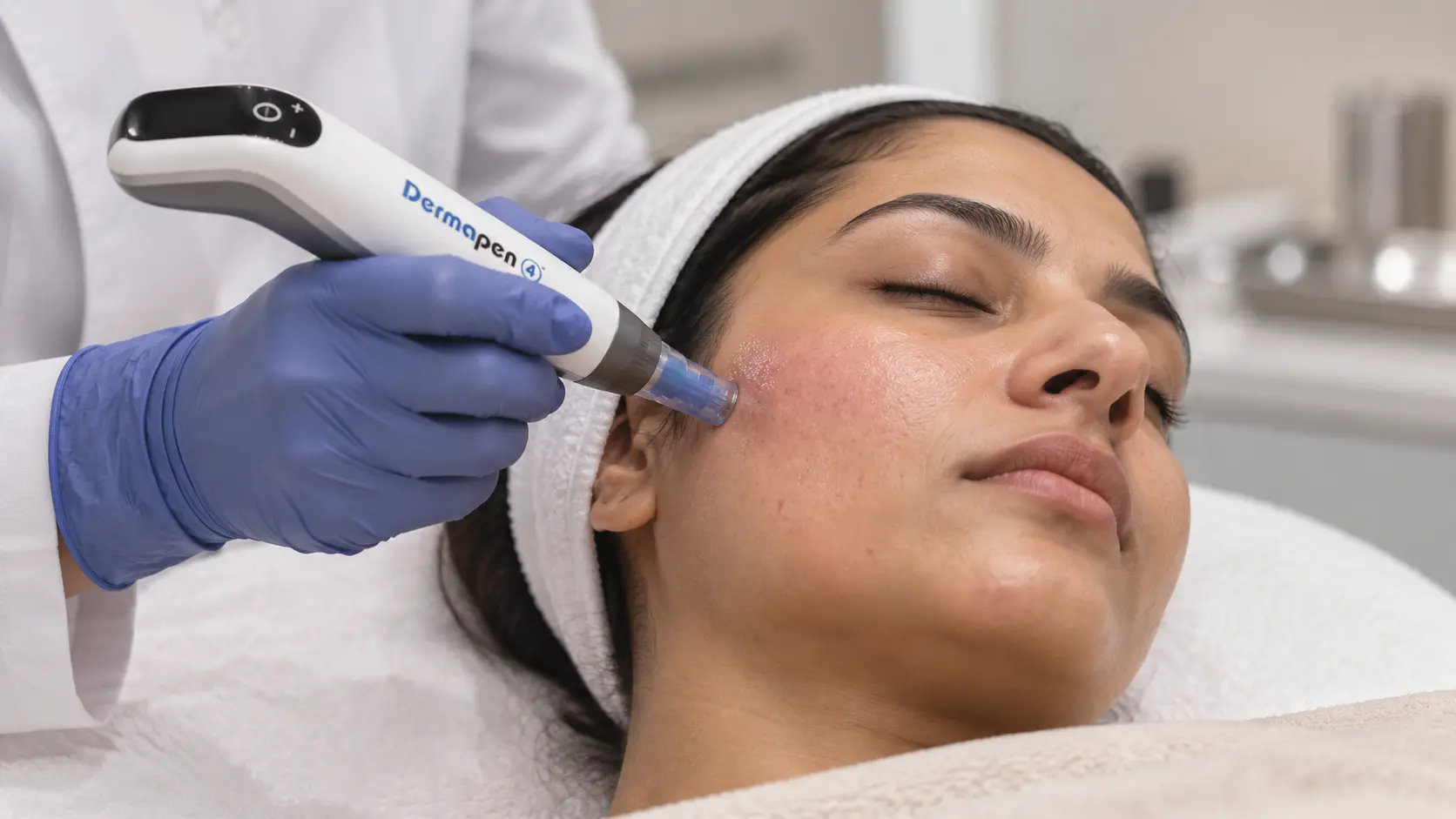
For texture-led concerns, I may consider Dermapen 4 or microneedling. A 2025 systematic review found microneedling was associated with generally high patient satisfaction and low rates of recorded adverse effects, although treatment schedules and outcome measures varied. [4]
Microneedling RF can add controlled thermal energy at selected dermal depths. For firmness, Density RF may be considered when radiofrequency heating fits the tissue pattern. Focused ultrasound such as Ultraformer MPT may be considered when deeper treatment planes are relevant.
Skin boosters or bioremodelling approaches have a different role. I may use them when hydration and skin quality are part of the problem, rather than treating them as substitutes for tightening.
Step 4: Allow biology time to respond
Collagen remodelling is gradual. Early swelling or temporary tightness is not the same as newly organised collagen. Changes develop over weeks and may continue for months, so I avoid judging a procedure too early or stacking treatments before the response has developed.
Side Effects and Safety: Why Technique Matters as Much as Technology
Common short-term reactions
Recovery varies by technique. Common short-term effects may include:
- Redness
- Swelling
- Tenderness
- Temporary sensitivity
- Mild dryness or scaling
- Bruising with some needle-based or injectable approaches
Most are temporary, but non-surgical does not mean risk-free. Selection, settings, technique and aftercare matter.
Indian skin needs thoughtful inflammation control
Indian skin includes a wide range of tones, but many patients have a meaningful risk of post-inflammatory hyperpigmentation after excessive inflammation.
That affects how I think about energy, needle depth, passes, session spacing and recovery. I would rather create a controlled therapeutic response than chase a dramatic endpoint that increases unnecessary inflammation.
Why I do not chase maximum energy or maximum injury
A collagen treatment works within a therapeutic window. Too much can increase pain, burns, pigmentation change, prolonged redness, scarring or unwanted tissue effects. I adjust parameters to the area, skin thickness and previous response. Maximum collagen is not a useful endpoint.
When I Prescribe Something Other Than a Collagen Treatment
When volume loss is actually the problem
If hollowing or structural volume loss is the main issue, dermal collagen stimulation alone may not recreate the missing support. A volume-focused strategy may be more relevant after assessment.
When expression lines are the dominant problem
Lines driven mainly by repeated muscle movement are different from fine lines caused by surface ageing. If muscle activity is the dominant driver, a collagen-only plan may give limited value.
When pigmentation or redness is making the skin look older
Uneven pigment, melasma, sun spots or persistent redness can make skin appear older even when firmness is relatively good. Treating the dominant pigment or vascular problem may be more meaningful than adding a collagen procedure.
When laxity has progressed beyond what a non-surgical collagen plan can reasonably achieve
Non-surgical collagen stimulation has limits. With advanced laxity, I explain those limits clearly. A device may offer modest tightening in selected patients, but it should not be presented as equivalent to surgical repositioning.
How I Combine Collagen Treatments Without Over-Treating the Skin
Texture-led plans
When texture, enlarged-looking pores or selected acne scars are dominant, I may build the plan around microneedling or microneedling RF. Scar type, skin thickness, pigmentation risk and previous response guide the choice.
Laxity-led plans
When firmness is the main concern, I may consider Density RF or focused ultrasound. They are not interchangeable because they deliver energy differently and can target different depths.
A 2025 systematic review of radiofrequency-based facial rejuvenation reported generally favourable outcomes, with redness and swelling among common transient effects, while also noting limitations in study methods and downtime reporting.
A systematic review of microfocused ultrasound found improvement in mild to moderate facial laxity, but protocols varied and longer-term evidence was limited.
Skin-quality-led plans
If hydration, fine crepiness and general skin quality are important, a skin booster or bioremodelling approach may sometimes be included. I see this as complementary when indicated, not as a replacement for treating laxity, scars or muscle-related ageing.
Why combination treatment does not mean doing everything together
Each treatment in a combination plan should have a job. I consider mechanism, recovery, inflammation load, pigmentation tendency and previous procedures. Combining too much too quickly may increase irritation and make it difficult to know what helped.
The minimum effective intervention principle
My preference is the minimum effective intervention. That may mean skincare and observation, or one device instead of three. I add another modality only when it addresses a separate concern. More procedures do not automatically create healthier skin.
What Makes Modern Collagen Stimulation Different: What the Science Actually Shows?
Controlled injury, controlled heat and mechanical signalling
Modern collagen treatments use different forms of controlled stimulation. Microneedling creates microscopic channels and a wound-healing response. Radiofrequency creates controlled tissue heating. Microneedling RF combines needle penetration with thermal energy. Focused ultrasound creates thermal coagulation points at selected depths.
They may all stimulate remodelling, but they are not interchangeable.
What research says about microneedling
The 2025 systematic review of microneedling for facial rejuvenation included 21 studies and 723 patients. Wrinkles, texture and photoageing were common endpoints. The review found generally high satisfaction and low reported adverse-event rates, but highlighted varying schedules and non-standardised outcome measures. [4]
That supports microneedling as a useful option in selected patients, not as one universal protocol.
What research says about radiofrequency
Radiofrequency studies support a role in non-surgical facial rejuvenation, including improvements in firmness and texture in selected patients. The evidence also shows why RF should be viewed as a technology category rather than one treatment. Devices, protocols, endpoints and study quality differ. [5]
Device design, energy delivery, cooling and operator technique influence the biological response.
What research says about focused ultrasound
Microfocused ultrasound creates controlled thermal zones at selected depths. The 2023 systematic review reported improvement in mild to moderate facial laxity and showed that results can develop over time. It also noted variable protocols and limited longer-term data. [6]
This supports selective use. The presence of laxity does not automatically make ultrasound the right choice.
Why I pay attention to study quality, not just positive headlines
A positive study does not answer every clinical question. I look at sample size, control groups, follow-up, device, patient selection, outcome measures and funding. I also separate statistical significance from clinical significance. A measurable change may be real but too small to matter to a particular patient.
What Most People Get Wrong About Collagen for Skin?
Myth 1: After 25, you lose exactly 1% of collagen every year
Age-related collagen decline is real, but the popular 1% every year statement should not be treated as a personal countdown. Genetics, UV exposure, hormones, smoking and inflammation all affect skin ageing.
A population estimate cannot tell me exactly how much collagen one individual has lost.
Myth 2: Drinking collagen sends collagen directly to my face
Oral collagen is digested. It does not travel intact from a drink to facial skin.
Some studies report benefits, but the evidence is less convincing when study quality and funding are examined. [3] I therefore discuss supplements more cautiously than many advertisements do.
Myth 3: A collagen cream can replace the collagen I have lost
Topical collagen may moisturise and make dry skin feel smoother. That is not the same as rebuilding deeper dermal collagen.
The product can still be useful as skincare. The claim simply needs to match what it can realistically do.
Myth 4: More heat, more needles or more pain means more collagen
Pain is not a measure of treatment quality. Neither is visible inflammation.
Needle and energy-based treatments have therapeutic ranges. Going beyond what the tissue needs can raise complication risk without guaranteeing a better result.
Myth 5: Every sagging face needs collagen stimulation
Facial ageing involves skin, fat, ligaments, muscle and bone. If the visible change is mainly due to deeper structural or volume change, treating only the dermis may disappoint.
Diagnosis comes before device selection.
Myth 6: One collagen treatment permanently stops ageing
No collagen procedure stops biological ageing. A treatment may improve a defined concern, but skin continues to age. Any future treatment should be based on how the skin changes, not on an automatic maintenance package.
Patient Questions I Often Get About Collagen
Can lost collagen in the skin actually be rebuilt?
Skin can produce new collagen, and several treatments stimulate remodelling. However, that does not restore skin to an earlier age or replace every structural change. Response depends on tissue quality, treatment method, depth and health factors. I focus on a defined concern rather than a promised percentage of new collagen.
Do collagen supplements really improve skin?
The evidence is mixed. Some trials report improvements in hydration, elasticity or wrinkles, but a 2025 meta-analysis found that apparent benefits were not seen in higher-quality studies or studies without pharmaceutical-company funding. [3] Supplements do not replace sun protection, balanced nutrition or appropriate dermatological care.
Which is better for collagen, microneedling, RF or ultrasound?
There is no single answer because they work differently.
Microneedling is often more relevant when controlled collagen induction and texture are priorities. Microneedling RF adds thermal energy at selected depths. Radiofrequency can be used for dermal heating and firmness. Focused ultrasound may suit deeper treatment planes.
I choose according to anatomy and indication, not trends.
How long does new collagen take to form after a treatment?
Collagen remodelling is gradual. Early redness, swelling or tightness should not be confused with mature new collagen. Depending on the procedure, meaningful remodelling is usually assessed over weeks to months, which is why planned review points matter.
At what age should I start thinking about collagen treatments?
There is no correct birthday.
Someone in their twenties may only need photoprotection and skincare. Another younger patient may have acne scars that justify collagen induction. An older patient may have good skin quality and no reason to start an energy-based procedure.
I treat the indication, not the age.
Which collagen-stimulating approach is suitable for Indian skin?
Indian skin is diverse, so I assess skin tone, tanning tendency, pigmentation history, acne activity, scars, barrier health, thickness and treatment area. For patients prone to post-inflammatory hyperpigmentation, inflammation control is especially important. Settings, depth, spacing and aftercare may need adjustment.
Citation Sources
- Fisher GJ, Wang B, Cui Y, Shi M, Zhao Y, Quan T, et al. Skin aging from the perspective of dermal fibroblasts: the interplay between the adaptation to the extracellular matrix microenvironment and cell autonomous processes. J Cell Commun Signal. 2023;17(3):523-529. https://pubmed.ncbi.nlm.nih.gov/37067763/ [link]
- Sitohang IBS, Makes WI, Sandora N, Suryanegara J. Topical tretinoin for treating photoaging: a systematic review of randomized controlled trials. Int J Womens Dermatol. 2022;8(1):e003. https://pubmed.ncbi.nlm.nih.gov/35620028/ [link]
- Myung SK, Park Y. Effects of Collagen Supplements on Skin Aging: A Systematic Review and Meta-Analysis of Randomized Controlled Trials. Am J Med. 2025;138(9):1264-1277. https://pubmed.ncbi.nlm.nih.gov/40324552/ [link]
- Foppiani JA, Fanning JE, Beltran K, Raska O, Hernandez Alvarez A, Taritsa I, et al. Microneedling for Facial Rejuvenation: A Systematic Review. Aesthetic Plast Surg. 2025;49(17):4949-4960. https://pubmed.ncbi.nlm.nih.gov/40542236/ [link]
- Kumar N, Suh DH, Lee SJ, Ryu HJ. Radiofrequency-Based Treatments for Facial Rejuvenation: A Systematic Review of Efficacy, Safety, and Patient-Centered Outcomes. Aesthet Surg J Open Forum. 2025;7:ojaf159. https://pubmed.ncbi.nlm.nih.gov/41426292/ [link]
- Contini M, Hollander MHJ, Vissink A, Schepers RH, Jansma J, Schortinghuis J. A Systematic Review of the Efficacy of Microfocused Ultrasound for Facial Skin Tightening. Int J Environ Res Public Health. 2023;20(2):1522. https://pubmed.ncbi.nlm.nih.gov/36674277/ [link]