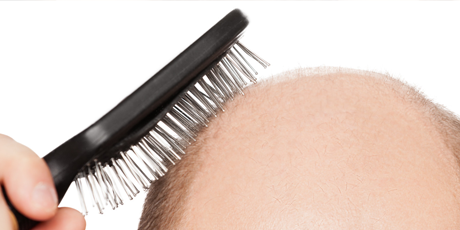

Hair loss can happen gradually or suddenly and can have diverse causes. Signs and symptoms differ depending on the causes and other factors.
Signs & symptoms
Hair loss can occur with different symptoms like
- Androgenetic alopecia (male pattern hair loss) – gradual and diffuse hair loss; can start from early twenties; hairline starts receding like letter ‘M’; hair loss is along frontal hairline, temples and on the crown gradually; left with hair only around ears, back and sides; sometimes complete baldness results.
- Female pattern hair loss – for some women, may start after menopause, but general and diffuse thinning can start early; hair thinning in central scalp, frontal forehead areas or broadening at where hair is parted.
- Alopecia areata – hair loss is sudden; circular, smooth bald patches appear; about 2.5 centimeters diameter size; affects scalp only initially but can extend to eyebrows, lashes and beard areas. Prior to hair-fall, tingling and itchiness may be present. Finger nails look pitted or ribbed.
- Alopecia totalis – hair loss is complete, all over scalp.
- Alopecia universalis – complete hair loss on body and scalp.
- Telogen effluvium – sudden and rapid hair shedding after a physical stress or mental trauma incidence; diffuse hair loss pattern occurring only in women. Handfuls of hair fall out when brushing, washing, or combing.
- Chronic telogen effluvium – alarmingly excessive hair loss of scalp upto 400-500 hairs can be lost per day ,persisiting for more than 6 months and has a fluctuant course for upto 6-7 years,but without apparent cause.This severe thinning is seen in women in the fourth and fifth decade of life and results in prominent bitemporal recession.
- Anagen effluvium – when chemotherapy causes sudden and rapid hair loss; can be all over the body and scalp; reversible after stopping chemo.
- Cicatricial alopecia – caused by another medical condition; sometimes itchy rash develops with inflammation; hair follicles are completely permanently destroyed with scar tissue formation.
Seeking medical help
Symptoms that should alert you to get medical help are
- Sudden, rapid and large amounts of hair loss.
- Patches of broken hair and itchy tendency to pull out hair.
- Change in scalp condition like scaly patches, rash or tingling.
- Hair loss coinciding with starting any medication.
- Signs of bacterial infection like
- Hot, red patches.
- Swelling.
- Red inflamed scalp.
- Excess pain.
- Tenderness.
- Ray like red-colored streaks.
- Pus discharge.
- Fever.
Outlook
Sudden hair loss may indicate an underlying treatable medical condition and timely diagnosis and treatment can successfully reverse hair loss.
[tab]
[tab_item title=”References”]
- University of Maryland Medical Center – Hair Loss Treatment view
- Mayo Clinic – Symptoms of Hair Loss view
- WebMD – Hair Loss Symptoms view
- American Association of Dermatology – Hair Loss Who Gets and Causes view
- John Hopkins Medicine Health Library – Hair Loss view
- NHS UK – Hair Loss Symptoms view
[/tab_item]
[/tab]